
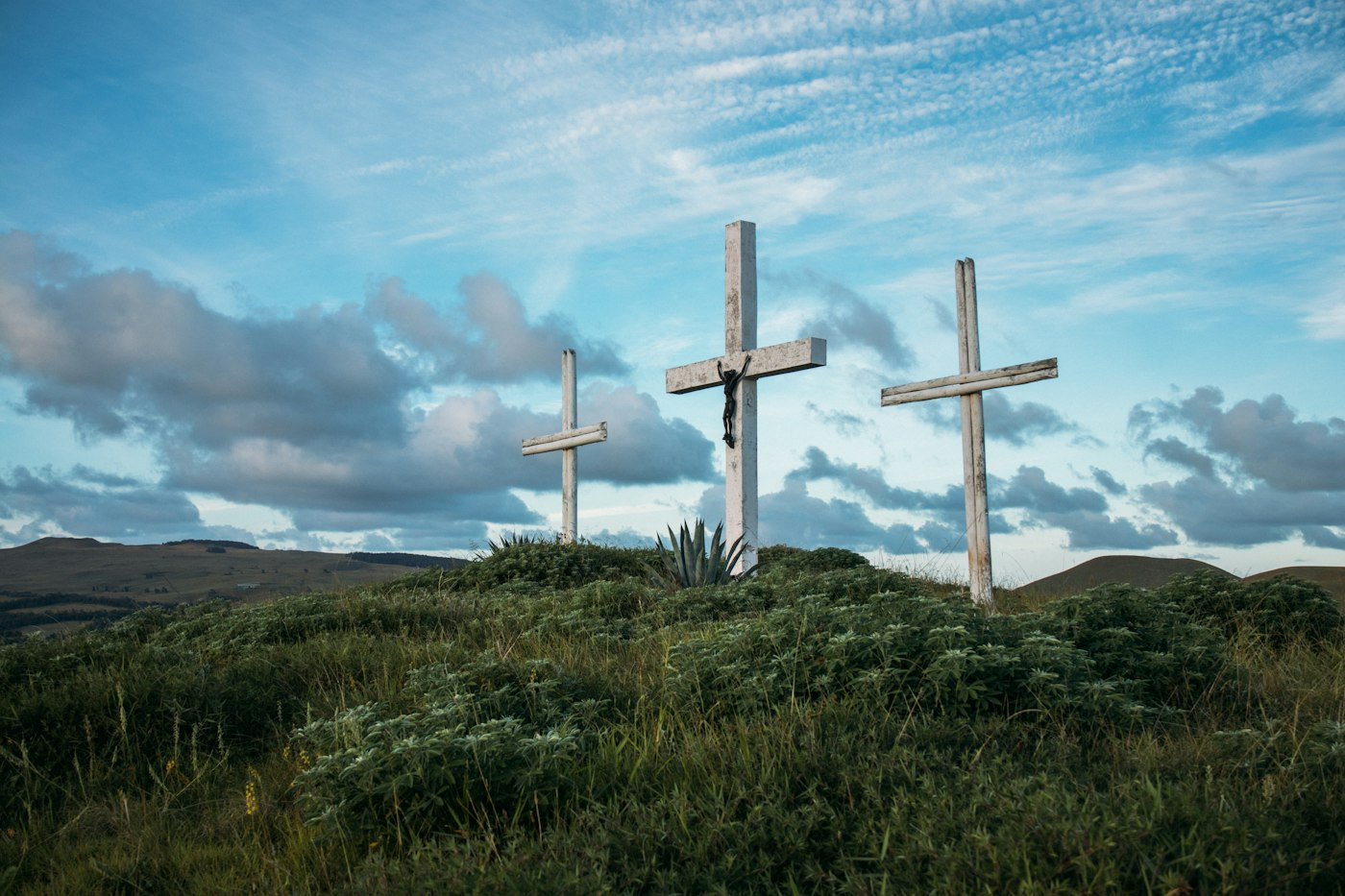
People often use the phrase “my cross to bear” for anything from a bad back to a difficult relative. But when Jesus first said the words, nobody heard them as a figure of speech. A cross meant one thing: a public, shameful death at the hands of the state. So what did Jesus mean when He told His followers to take one up, and what does it mean for us in Lent?
The Saying in Context
Matthew, Mark and Luke all record the saying, and in each case it follows Peter’s confession that Jesus is the Christ and Jesus’ first clear prediction of His own death. Luke’s version adds one word that matters: “If any man will come after me, let him deny himself, and take up his cross daily, and follow me” (Luke 9:23, KJV).
Then comes the paradox: “For whosoever will save his life shall lose it: but whosoever will lose his life for my sake, the same shall save it” (Luke 9:24). Jesus is describing a whole way of life, not a single heroic moment.
What It Meant to the First Hearers
In the Roman world, a condemned man carried the crossbeam of his own cross through the streets to the place of execution. To “take up a cross” was to walk that road: to be publicly identified as condemned, to have given up all claim on your own future, to be going somewhere you would not return from.
So Jesus’ call had at least three edges. It meant public identification with Him, whatever people thought. It meant the end of self-rule; a man carrying a cross is no longer managing his own life. And it meant a willingness to suffer for His sake, even to the point of death, as many of those first disciples eventually did.
What It Does Not Mean
- It is not every hardship. Illness, grief and ordinary trouble are real burdens, and God cares about them, but the cross in this saying is specifically what we take on because we follow Jesus.
- It is not self-hatred. Denying yourself means refusing to make yourself the center, not despising the person God made.
- It is not seeking misery. Jesus never asked for suffering as a goal. He asked for obedience, and accepted the suffering that came with it.
- It is not a way to earn salvation. We carry the cross because we belong to Him, not in order to belong.
Daily
Luke’s word “daily” rescues this teaching from being only about martyrdom. Most believers will never face a literal execution. But every day presents small deaths: the comment we do not make, the grudge we release, the money we give, the comfort we set aside, the truth we tell when a lie would be easier, the loyalty to Christ we show when it would be simpler to stay quiet.
Paul described his own life this way: “I am crucified with Christ: nevertheless I live; yet not I, but Christ liveth in me” (Galatians 2:20). The cross is both a death and a doorway. What dies is the old self-centered life. What lives is Christ in us.
Lent as Cross-Carrying Practice
The disciplines of Lent are small rehearsals of this larger call. Giving up a meal or a habit is not the cross, but it trains the muscle that says no to self and yes to God. Serving someone quietly, forgiving a wrong, speaking openly about your faith: these are the daily shape of following a crucified Lord.
And the saying ends with a promise, not just a demand. Whoever loses his life for Jesus’ sake will save it. The road of the cross leads to resurrection. It did for Him, and He has promised it will for everyone who follows.
Going Deeper: The Rebuke That Came First
The call to take up the cross did not come out of nowhere. In Matthew and Mark, it follows a sharp exchange. When Jesus first explained that He must suffer and be killed, Peter took Him aside and rebuked Him: “Be it far from thee, Lord: this shall not be unto thee” (Matthew 16:22). Jesus answered with some of the strongest words He ever spoke to a disciple: “Get thee behind me, Satan … for thou savourest not the things that be of God, but those that be of men” (Matthew 16:23).
Peter had just confessed Jesus as the Christ, and he meant it. But his idea of the Messiah had no room for a cross. He wanted a crown without suffering. Only after correcting that idea did Jesus turn to everyone and say, “If any man will come after me.” The cross was not only His path. It would be the shape of theirs too.
We are often like Peter. We welcome a Savior who blesses and protects, but we resist a Lord who calls us to lay our lives down. Lent gives us room to let Jesus correct our expectations.
The Man Who Literally Carried It
On the road to Golgotha, the soldiers seized “one Simon, a Cyrenian, coming out of the country, and on him they laid the cross, that he might bear it after Jesus” (Luke 23:26). Luke’s wording is striking. Simon carried the cross “after Jesus,” behind Him, following in His steps. Whether he understood it or not, Simon became a living picture of the saying Jesus had spoken months before.
Mark adds that Simon was “the father of Alexander and Rufus” (Mark 15:21), naming his sons as if the first readers would know them. That small detail has led many to believe Simon’s family came to faith. A man forced to carry a cross may have found, along that road, the One who carried his sins.
What “Deny Himself” Means
Before taking up the cross, Jesus says to deny oneself. This is not the same as denying oneself things, though that may be part of it. To deny yourself is to say no to self as the ruler of your life. It means:
- Letting Jesus, not my preferences, have the final say in my choices.
- Releasing my need to be right, admired or in control.
- Trusting that His will is better than mine, even when it is harder.
Questions Readers Ask
Is my illness or hardship my cross?
Hardships are real, and God draws near to us in them. But the cross in Jesus’ saying is what we accept because we follow Him. Even so, how we bear ordinary hardships, with faith and patience, can become part of following Him.
What if I am afraid of what it might cost?
That fear is honest. Remember that Jesus never asks us to carry the cross alone. He goes ahead of us, and He promises life on the other side of loss.
Lord Jesus, correct my ideas of what following You should look like. Help me deny myself and take up my cross today, walking after You as Simon did. Thank You that You carried the heaviest cross for me. Amen.