
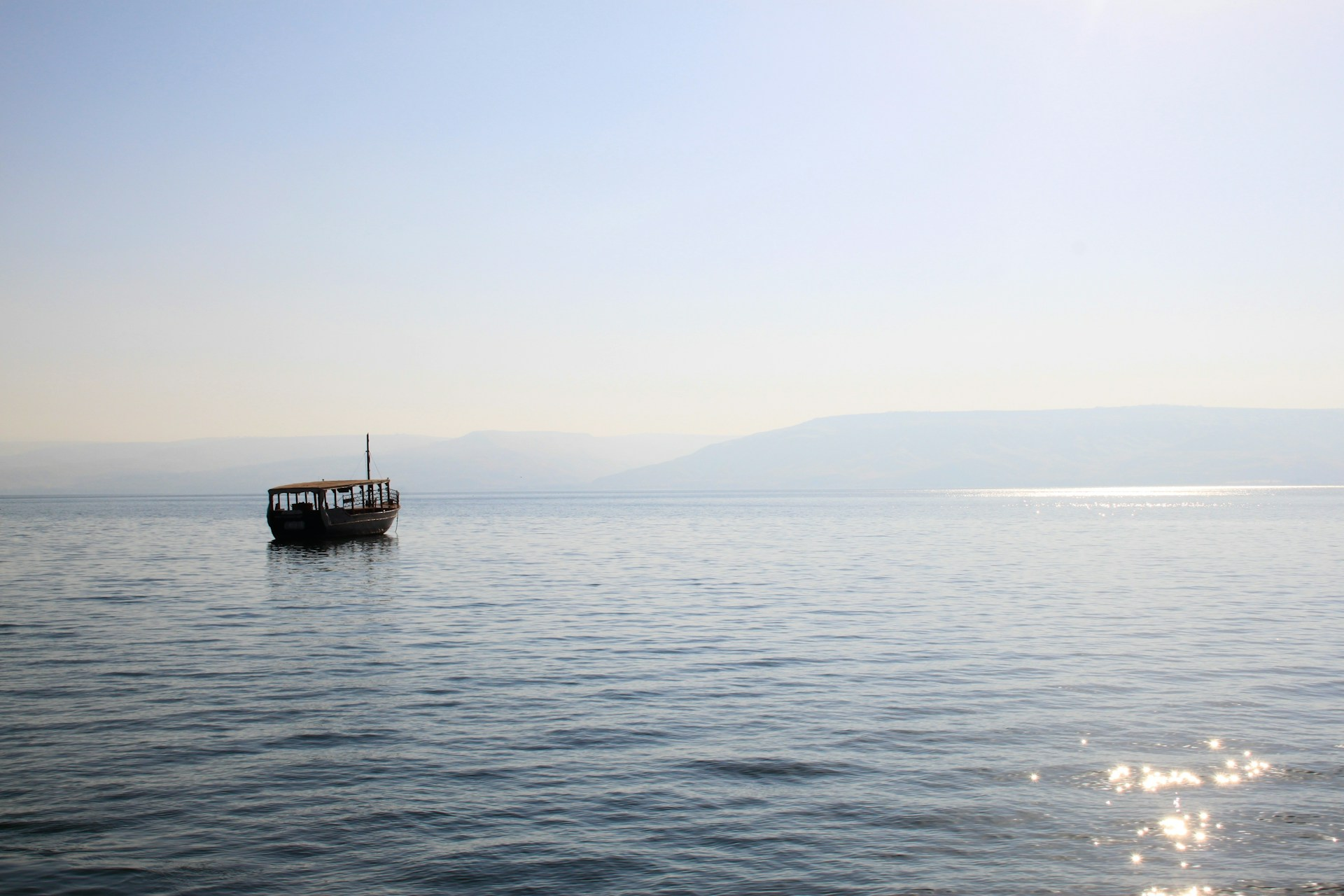
Summer draws many people to lakes, and one lake stands at the center of the Gospels. Much of Jesus’ public ministry took place on or near the Sea of Galilee. He called fishermen from its shores, taught crowds from a boat on its waters, fed thousands on its hillsides and calmed its storms. Knowing a little about this lake brings many familiar stories to life.
A Lake With Many Names
Despite its name, the Sea of Galilee is a freshwater lake, fed by the Jordan River flowing down from the north. Scripture calls it by several names. In the Old Testament it is the sea of Chinnereth (Numbers 34:11), a name many connect with the Hebrew word for a harp, perhaps because of its shape. Luke calls it the lake of Gennesaret (Luke 5:1). John also calls it the sea of Tiberias (John 6:1), after the city Herod Antipas built on its western shore and named for the Roman emperor.
The lake lies well below sea level, ringed by hills, and is small enough to see across on a clear day.
Towns Along the Shore
The shoreline was dotted with fishing villages and towns. Capernaum, on the northern shore, became Jesus’ base; Matthew calls it “his own city” (Matthew 9:1). Simon Peter and Andrew had a house there (Mark 1:29). Bethsaida is named as the city of Philip, Andrew and Peter (John 1:44). Magdala, on the western shore, is generally considered the hometown of Mary Magdalene.
Fishing drove the local economy. Zebedee’s family worked with hired servants and partners. In 1986, during a drought that lowered the water level, the remains of a fishing boat from around the time of Jesus were found in the mud near the shore, giving a glimpse of the kind of vessel the disciples would have used.
Sudden Storms
Because the lake sits low among hills, winds can rush down onto the water with little warning and whip up dangerous waves. The disciples, many of them experienced fishermen, knew this well, which makes their fear in Mark 4 all the more telling.
“And there arose a great storm of wind, and the waves beat into the ship, so that it was now full. And he was in the hinder part of the ship, asleep on a pillow: and they awake him, and say unto him, Master, carest thou not that we perish?” (Mark 4:37-38, KJV). Jesus “rebuked the wind, and said unto the sea, Peace, be still. And the wind ceased, and there was a great calm” (Mark 4:39). Their fear of the storm turned into a deeper awe: “What manner of man is this, that even the wind and the sea obey him?” (Mark 4:41).
The psalmist had praised the God who “maketh the storm a calm, so that the waves thereof are still” (Psalm 107:29). On the Sea of Galilee, the disciples watched Jesus do exactly that.
Stories on and Around the Water
- Jesus called Simon, Andrew, James and John from their nets (Mark 1:16-20).
- He taught from a boat while crowds stood on the shore (Mark 4:1).
- He walked on the water and caught a sinking Peter (Matthew 14:22-33).
- He fed the five thousand on a nearby hillside (John 6:1-13).
- After His resurrection, He cooked breakfast for His disciples on the beach (John 21).
The Lake and Your Life
Isaiah had foretold that “Galilee of the nations” would see a great light (Isaiah 9:1-2), and Matthew saw that fulfilled in Jesus’ ministry by the sea (Matthew 4:15-16). The ordinary waters of working families became the setting for extraordinary grace. Wherever you spend time by the water this summer, remember that Jesus met people at their workplaces and in their storms. He still does.
Going Deeper: Life on the Lake in Jesus’ Day
The Sea of Galilee is not large by modern standards. It is commonly described as roughly thirteen miles long and about eight miles across at its widest, and it is often called the lowest freshwater lake on earth, lying some seven hundred feet below sea level. That small size helps explain how Jesus could cross it in an evening, teach on one side in the morning and be found on the other by afternoon. The crowds in John 6 simply walked around the shore to find Him.
The Gospels mention different kinds of fishing nets. Simon and Andrew were “casting a net into the sea” (Mark 1:16), likely a circular throw net cast by hand from the shallows. James and John were “mending their nets” in a boat with their father (Mark 1:19), the larger nets used from boats, often at night. Jesus also told a parable about a dragnet “cast into the sea” that “gathered of every kind” (Matthew 13:47). Each of these images would have been instantly familiar to people who lived along the shore.
The lake was also something of a border. The western and northern shores were largely Jewish towns. The eastern side included the region of the Decapolis, a group of cities shaped by Greek culture. When Jesus crossed to “the country of the Gadarenes” (Mark 5:1) and met a man possessed by demons, He was stepping into Gentile territory, where people kept herds of swine. His trips across the water often carried Him toward people others avoided.
Reading the Gospels With the Lake in Mind
Here is a simple way to let the geography deepen your Bible reading this summer.
- Read Mark 1 through 6 in one or two sittings. Watch how often Jesus is “by the sea side,” in a ship or crossing “to the other side.”
- Notice the movement. When He crosses the lake, ask who is waiting on the far shore.
- Mark the storms. Compare Mark 4:35-41 with Mark 6:45-52. In the first, Jesus is in the boat. In the second, He comes to them on the water.
- Finish with John 21. Notice how the story ends where it began: with fishermen, nets, a miraculous catch and a call to follow.
What This Means for You
Here on the Carolina coast, I often watch fishermen on the piers and in small boats heading out before sunrise. They are ordinary working people, and many of them know a great deal about wind and water. I think about how Jesus chose men just like them. He did not set up His ministry in a palace or a temple courtyard. He went to the docks.
- Your ordinary place matters. The office, the kitchen, the shop floor or the boat can be where Jesus meets you.
- Your storms are not hidden from Him. The same Lord who stilled the wind on Galilee is present in yours.
- Your “other side” may be a calling. There may be people across a social or cultural divide whom Jesus wants you to reach.
Questions Readers Ask
Can people still visit the Sea of Galilee?
Yes. Many travelers to the Holy Land visit the lake, and some take boat rides on its waters. Those who go often say the Gospels never read quite the same afterward. If you cannot travel, a good Bible atlas can help you picture the setting.
Why is it called a “sea” if it is a lake?
The biblical writers used the word for “sea” more broadly than we do, for large bodies of water in general. Luke, who traveled widely, chose the word “lake” instead.
Is Capernaum’s synagogue the one Jesus taught in?
Visitors today see the ruins of a later synagogue, but many believe it stands on or near the site of the earlier one where Jesus taught (Mark 1:21).